The Challenge

The complexity behind portfolio emissions

For fund managers and institutional investors, measuring financed emissions means navigating diverse assets, uneven data and multiple reporting requirements.

From listed equities to private investments and real estate, asset classes require different measurement approaches under the Partnership for Carbon Accounting Financials (PCAF) Standard. Data availability also varies by issuer, sector and geography.
Managers need to report across schemes, funds and individual holdings, while responding to evolving climate disclosure requirements in Australia, New Zealand and internationally.
Assurance teams need to trace calculations to source data and verify methodologies. Gaps in supporting evidence mean more follow-up, greater cost and harder-to-assure results.
An ongoing challenge for assurance teams
Assurance teams must also validate the underlying calculations, methodologies and supporting evidence across diverse portfolios.
Common feedback from assurance teams:
“
One of the biggest challenges with assuring financed emissions is the time spent tracing calculations back to their sources. We often need to locate issuer disclosures ourselves, request supporting information and verify different methodologies across a wide range of asset classes. This increases assurance costs for clients and makes it harder to obtain the evidence needed to support an assurance conclusion.
Understand what drives your portfolio emissions
View emissions from scheme to holding level. Analyse by asset class, sector, company and geography, and track changes in emissions intensity and investment exposure.
Measure with reported and estimated data
Combine reported emissions with local and sector-based estimates where data is missing. Apply relevant PCAF methodologies and use data quality scores to prioritise improvements.
Trace the evidence behind the results
Access each holding’s emissions and financial data, methodologies and source references, with supporting evidence for internal review, investor reporting and external assurance.
how it works

From holdings data to portfolio intelligence

01

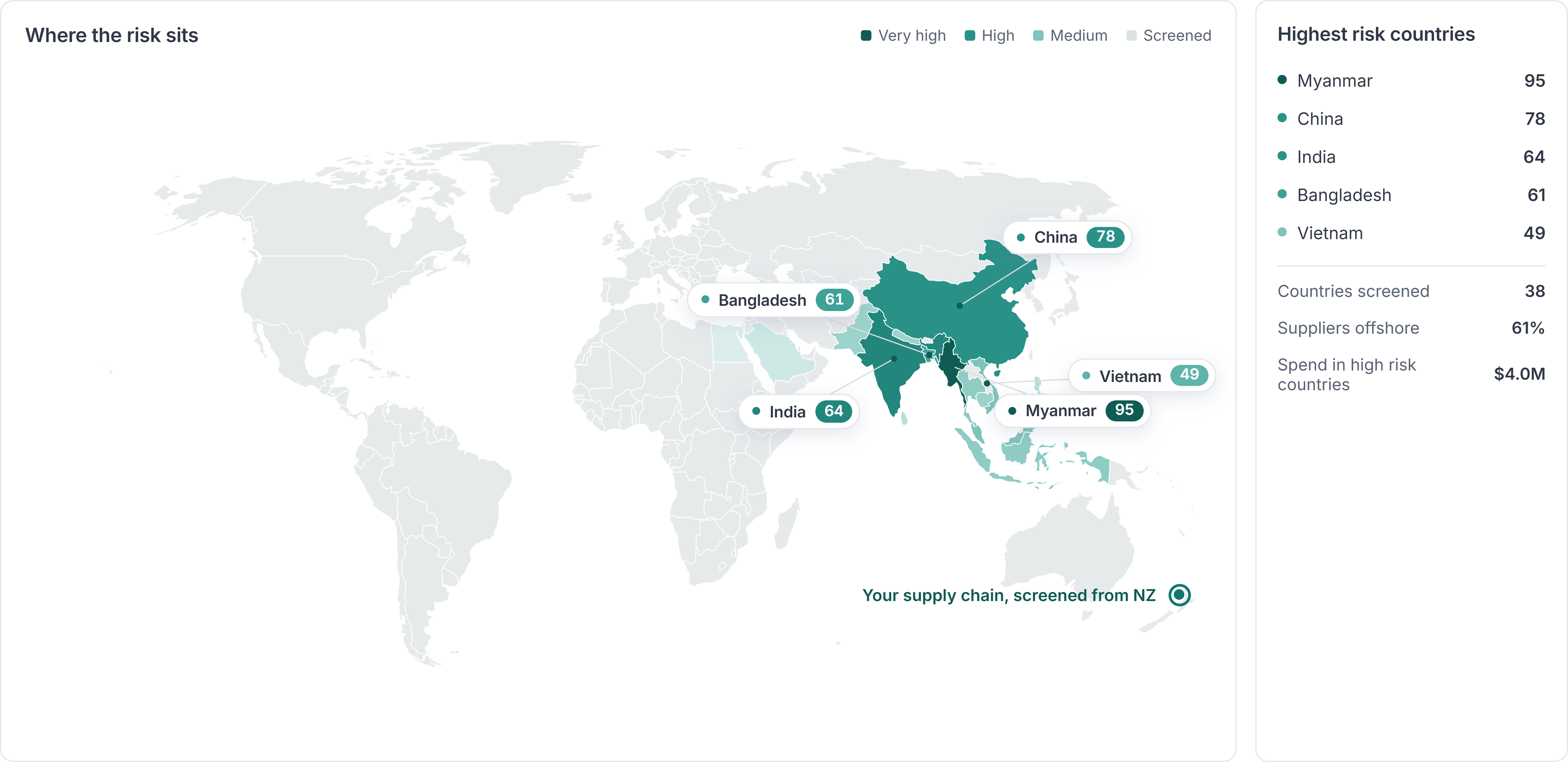
Map where modern slavery risk sits in your supply chain

Set up schemes, funds and reporting requirements. Identify the asset classes and exposures to measure.

02

Understand your supplier level risk

Link holdings to issuers and instruments. Access emissions and financial data through Generate Zero’s Global Business Carbon Database, with estimates where reported emissions are unavailable.

03

Understand your supplier level risk

Apply asset-class-specific PCAF methodologies to calculate attribution factors, financed emissions and data quality scores. Retain sources and assumptions.

04

Build the evidence base for your statement

Explore results from scheme to holding level, investigate emissions trends and prepare data for portfolio analysis, climate disclosures and assurance.

how it comes together

Global intelligence.
Local context.

GLOBAL
01
Global risk intelligence
Country, sector, commodity and company-level risk indicators from leading international datasets.
LOCAL
02
Australia & New Zealand intelligence
Local employment, labour, health and safety, enforcement, regulatory and company data adds critical context.
COMPANY
03
Company-level intelligence
Identify relevant events, adverse information and other company-specific signals.
Regulatory context

Prepare for evolving modern slavery requirements
Australia
Australia's Modern Slavery Act requires reporting entities to identify and report on modern slavery risks in their operations and supply chains, and the actions taken to address those risks.​
New Zealand
Modern slavery legislation is progressing through Parliament, increasing the focus on how organisations identify and manage risk across their supply chains.​
One platform for your sustainability data
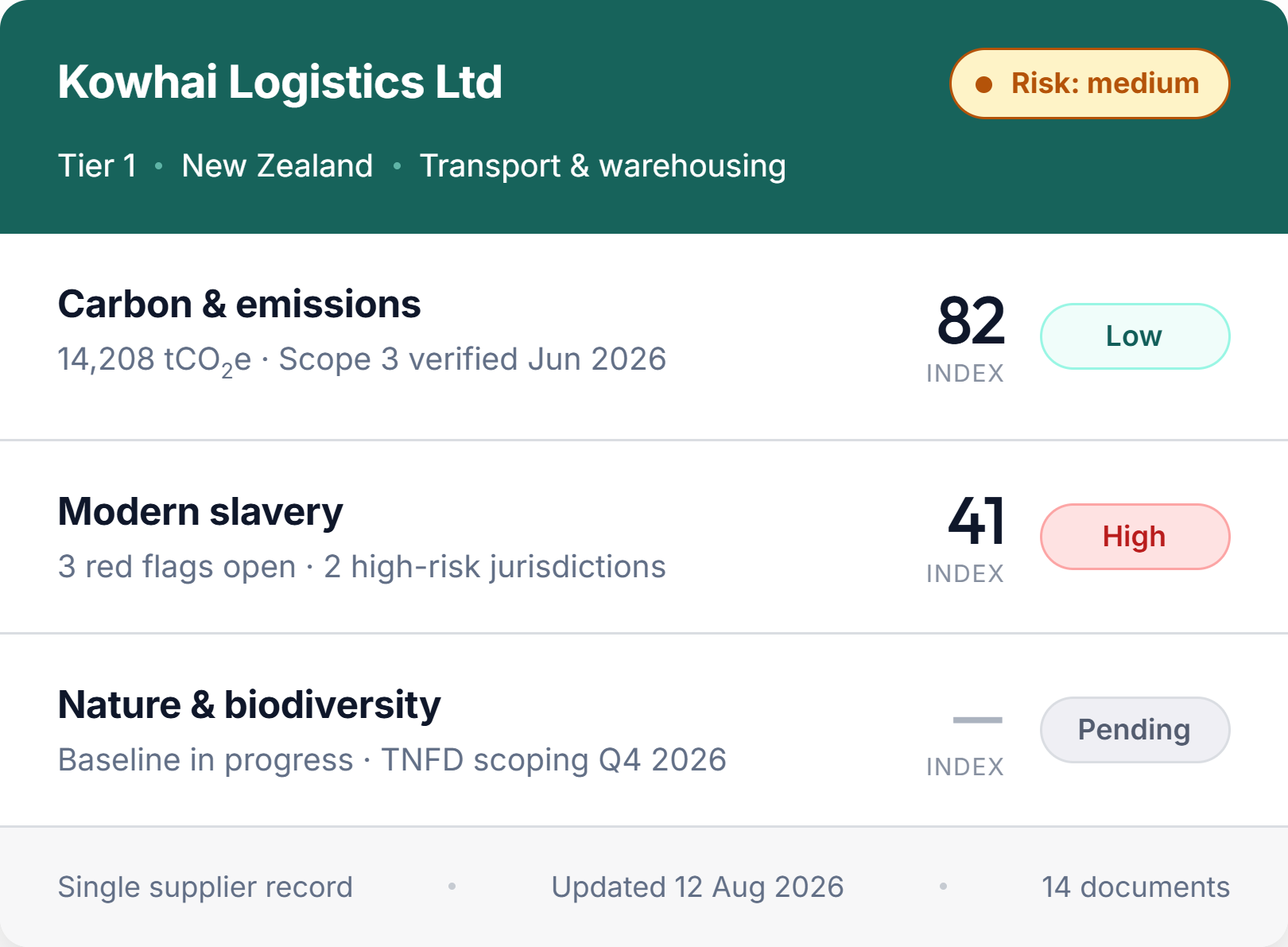
Modern slavery doesn't need to sit in another silo.
Bring modern slavery risk intelligence together with your carbon, financed emissions, cloud and AI emissions, reduction and sustainability reporting data in Generate Zero.