Who Owns AI Emissions? The Accountability Gap Organisations Need to Address
Read moreIdentify, assess and monitor modern slavery risk across your supply chain. Turn compliance obligations into actionable, audit-ready insight.


August 13, 2026
.png)

At the same time, they are becoming significant contributors to enterprise cost, energy consumption, and emissions. Despite this, many organisations still lack a clear and complete understanding of the true environmental impact of their cloud and AI usage.
As adoption continues to accelerate, expectations are shifting. Organisations are increasingly required to apply the same level of discipline to AI and cloud as they do to broader carbon reporting. This includes accurate measurement, audit-ready data, and alignment with financial decision making. What was once considered a technical or operational concern is now becoming a material issue for sustainability, risk, and governance.
Generate Zero’s Cloud and AI emissions capability has been developed to address this gap. Delivered in partnership with Greenpixie, a specialist in cloud and AI emissions data, the solution enriches cloud billing data to provide a detailed, auditable view of both cost and emissions. It enables analysis across business units, teams, and specific activities, giving organisations a level of visibility that has not previously been possible.
Many organisations rely on reporting from cloud providers such as Amazon Web Services, Microsoft Azure, and Google Cloud Platform to understand their cloud-related emissions. While this data provides a useful starting point, it is not designed to meet the requirements of audit, compliance, or informed decision making.
Provider-level reporting introduces several limitations that become more significant in a compliance-driven environment:
These gaps create both reporting risk and missed opportunities to optimise cost and performance.
Generate Zero extends beyond provider reporting to deliver a complete and audit-ready view of cloud and AI emissions. Rather than relying on high-level estimates, the platform connects directly to cloud billing data and enriches it with additional emissions intelligence to produce a more accurate and decision-ready dataset.
This enables organisations to move from static reporting toa more dynamic and actionable understanding of their cloud and AI footprint.
Key capabilities include:
This approach ensures emissions data can be trusted, interrogated, and used to support both reporting and operational decisions.
Measurement alone does not deliver value unless it leads to action. Organisations need to translate emissions data into decisions that reduce both environmental impact and operational cost.
Generate Zero supports this through its Reduction Planning module, which connects emissions insights directly to practical optimisation strategies. This allows organisations to identify where changes will have the greatest impact and prioritise actions accordingly.
Typical optimisation opportunities include:
By linking emissions data to these actions, organisations can move beyond reporting and begin to actively manage their cloud and AI footprint.
AI and cloud emissions are no longer a secondary or invisible issue. They are a measurable and increasingly material component of enterprise sustainability, cost management, and risk. Organisations that cannot quantify this impact will face increasing pressure as disclosure requirements evolve and stakeholders demand greater transparency.
Generate Zero brings this capability into a single platform, combining audit-ready emissions data, near real-time visibility, and clear pathways to reduce both cost and impact. By embedding this into existing workflows, organisations can treat cloud and AI emissions with the same level of rigour as financial and carbon reporting.
AI and cloud emissions are now measurable and manageable. The opportunity now is to use that visibility to make better decisions.
Book a demo to see how Generate Zero delivers audit-ready insights, real-time visibility, and clear pathways to reduce cost and impact.
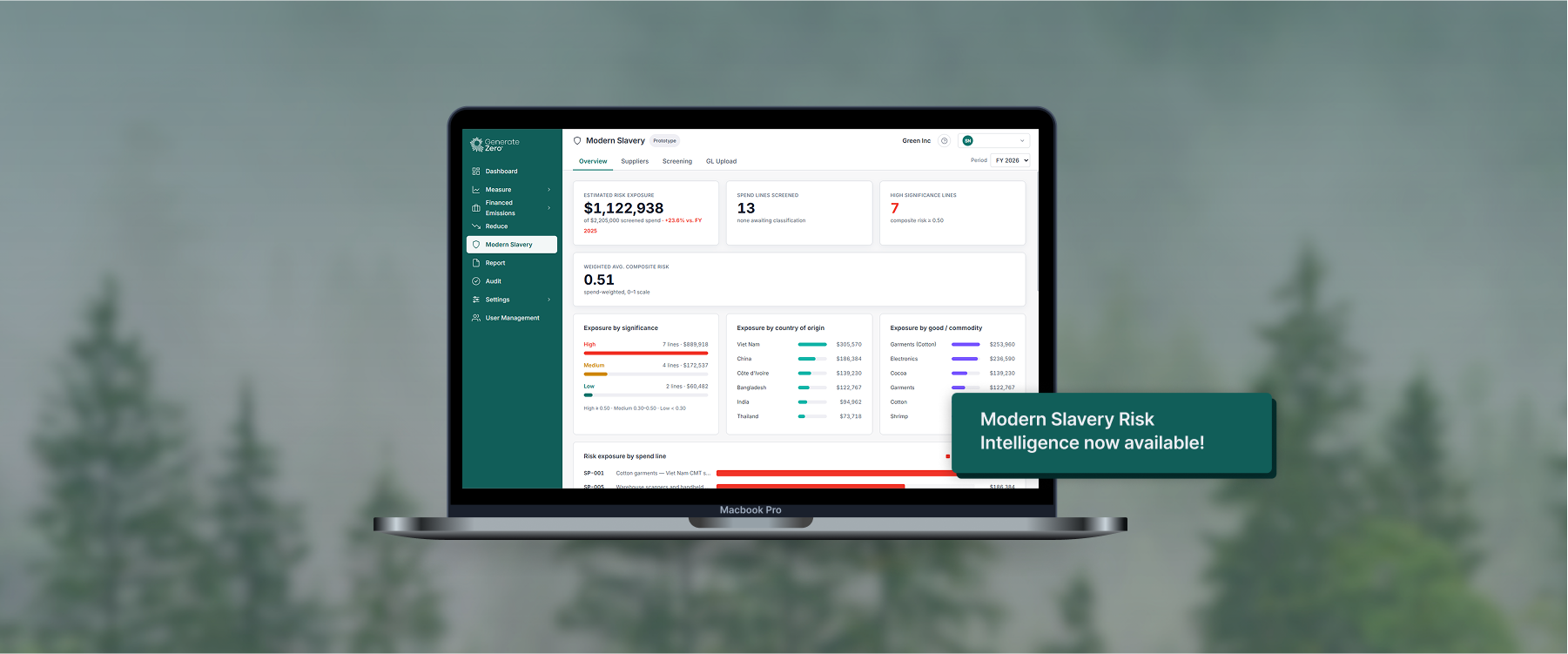
Identify, assess and monitor modern slavery risk across your supply chain. Turn compliance obligations into actionable, audit-ready insight.

Explore how MFAT’s solar project delivers cost savings, emissions reduction, and how scenario modelling supports smarter sustainability decisions.

Practical guidance for a successful implementation


