

Who Owns AI Emissions? The Accountability Gap Organisations Need to Address
Read moreIdentify, assess and monitor modern slavery risk across your supply chain. Turn compliance obligations into actionable, audit-ready insight.


Carbon accounting software implementation requires careful planning, high-quality inputs, and thoughtful decisions about how you structure and categorise your business activities. From defining your reporting scope to securing and managing data, every step requires attention to detail.
Here’s what to consider when onboarding a new system:
Do your project timelines align with upcoming reporting, audit, or disclosure requirements?
Your implementation should align with reporting, audit, and disclosure requirement deadlines. Request a detailed project plan from your provider and confirm roles and responsibilities for both parties.
Being clear on timelines and expectations prevents last-minute rushes and ensures the rollout progresses smoothly.
Who should be accountable for delivery, oversight, and data quality?
A successful implementation relies on the right people. Your team should include data owners, a project manager to oversee timelines and accountability, and a system owner responsible for loading and reviewing data. Deep carbon reporting and sustainability knowledge is essential.
Decide whether your organisation will manage the project in-house or whether some tasks can be supported by your software provider or a consultant.
Is your IT function prepared to support system access and security requirements?
Before you start, ensure you have proper access to your software. Determine whether your provider supports Single Sign-On (SSO) and involve your IT team early to approve or set up access.
Clarifying how your provider will support you during this stage, and pre-booking internal IT support, helps prevent delays and ensures the project can get off to a smooth start.
What entities, activities, and emissions categories will be included?
It is important to establish the scope of your carbon reporting before you begin. Decide which consolidation method you will use – equity, financial, or operational control – and clearly define what is in and out of scope. Identify which data sources are material, how much of your Scope 3 inventory you intend to report, and, if you have investments or are a bank or insurer, consider whether financed emissions should be included alongside operational emissions.
Your reporting approach should align with recognised standards such as the GHG Protocol, including Scope 1, Scope 2 (market-based and location-based), and Scope 3 emissions where applicable.
Confirm that your provider can support these requirements, as clear definitions at this stage prevent confusion and rework later.
At what level of detail do you need to measure and report emissions?
Getting your organisational structure right from the start is crucial. Consider the level at which you want to report, whether by business unit, location, or both, and how granular your data needs to be to support meaningful reduction decisions. It is important to ensure that your chosen carbon accounting platform can support this level of detail and allow you to report down to the granularity you require. Striking the right balance between granularity and practicality is key, so don't try to run before you can walk.
Too much complexity can create unnecessary mapping work and ongoing maintenance challenges, while too little detail may limit the insights you can generate and the decisions you can make.
How will prior emissions data be migrated and validated?
Whether you’re switching platforms or graduating from spreadsheets, you’ll want to ensure historic emissions are represented in your new system. Confirm how the software handles bulk imports, the format your current data should be in, and the level of detail required, such as business unit or sub-category.
It is important to ensure that imported totals align with previously disclosed values to maintain consistency and credibility, and that any data quality improvements made are well documented and variances explained.
Which emission factors will be used, and who will maintain them over time?
Decide which emission factors your organisation will use, and how they will be integrated into your software, including any paid subscriptions that may be required. Some providers manage access to emission factor databases on your behalf, while others require you to source and maintain them directly.
It is important to be clear on what responsibilities sit with your team and what is supported by the provider, ensuring the process runs smoothly from the outset. Consider how market-based and location-based energy data will be handled, especially if you require dual reporting.
Addressing emission factor selection and governance early helps avoid reporting gaps, inconsistencies, and rework later in the implementation process.
Where will your data come from, and in what format should it be supplied?
Identify all data sources required for reporting and consider the most reliable and consistent formats for each. Where possible, request that suppliers provide data in a structured format – many offer different reporting options – and aim for CSV or Excel files rather than unstructured PDFs.
Auditors will want to see data in its rawest form, so minimising manual handling not only streamlines the audit process but also helps ensure a successful and accurate reporting outcome.
What documentation is required to support audit transparency?
Finally, establish clear rules for assigning emission factors and managing data processing. For example, ensure that transmission and distribution (T&D) losses for electricity are correctly accounted for and recorded as separate line items.
Define how exclusions will be handled and decide how shared facilities should be apportioned across business units. Clarify what data should be excluded or treated differently and document all assumptions and uncertainties.
This documentation is essential for transparency and will be reviewed during audits, helping to reduce risk and strengthen credibility.
Implementing carbon accounting software is as much about governance, data integrity, and reporting clarity as it is about technology. Taking the time to define scope, establish ownership, align with recognised standards, and structure data appropriately will reduce risk and support more reliable reporting outcomes.
Addressing these considerations early helps avoid unnecessary rework and positions your organisation for smoother audit and disclosure processes.
-----
At Generate Zero, our team of project management, data, and sustainability specialists guides clients through every stage of carbon accounting software implementation. With experience across multiple industries, we understand the common challenges and key decisions that impact success.
From complex data mapping to project planning, we help you navigate the process and ensure a smooth, successful implementation.
If you are evaluating carbon accounting software or preparing for audit and disclosure requirements, speak to our team to discuss your implementation approach. Contact Us >
Timelines vary depending on organisational complexity and data availability but typically range from several weeks to several months.
Carbon accounting software requires activity data across all business operations that are material to an organisation’s greenhouse gas footprint. This typically includes energy use, fuel consumption, travel, logistics, procurement, waste, water, and supply chain emissions.
The exact data requirements depend on reporting boundaries, regulatory obligations, and materiality assessments. As reporting matures, organisations may incorporate more granular supplier or product-level data to improve accuracy and transparency.
Most enterprise platforms support Scope 3 reporting, including upstream and downstream supply chain emissions. Calculations can use spend-based, industry-average, supplier-specific, or hybrid emission factors depending on data availability.
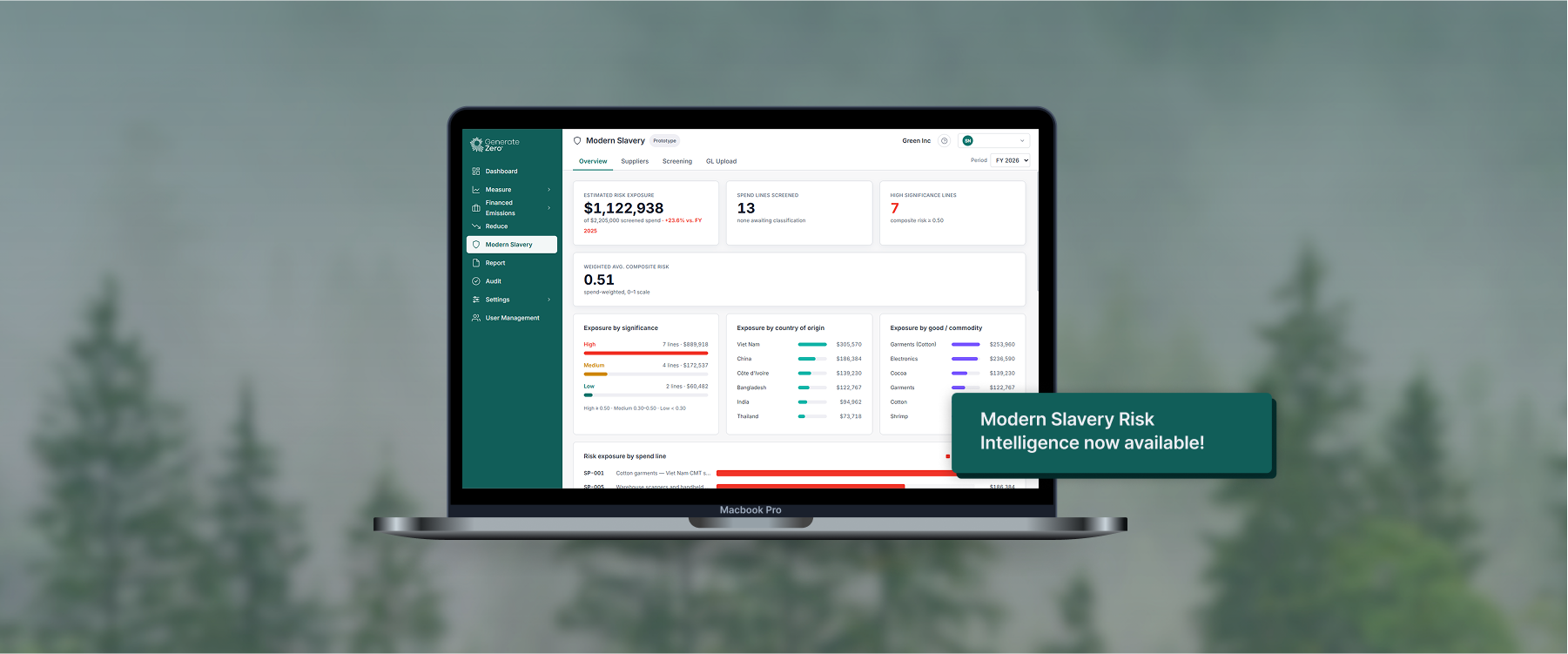
Identify, assess and monitor modern slavery risk across your supply chain. Turn compliance obligations into actionable, audit-ready insight.
.png)
Measure and manage AI and cloud emissions with audit-ready data. Gain real-time visibility, reduce cost, and meet disclosure requirements.

Explore how MFAT’s solar project delivers cost savings, emissions reduction, and how scenario modelling supports smarter sustainability decisions.


