Who Owns AI Emissions? The Accountability Gap Organisations Need to Address
Read moreIdentify, assess and monitor modern slavery risk across your supply chain. Turn compliance obligations into actionable, audit-ready insight.


February 26, 2026
.png)

With the introduction of Australian Sustainability Reporting Standards (ASRS), many organisations are focused on what they need to disclose. What often gets overlooked is how those disclosures will be assessed by auditors.
From our experience supporting many organisations through sustainability and climate-related audits, this is where the pressure tends to emerge. ASRS assurance is expected to move over time from limited toward reasonable assurance, and that shift brings ASRS much closer to the disciplines of financial audit than traditional sustainability reporting.
While limited assurance places greater reliance on higher-level indicators such as trends over time, reasonable assurance requires deeper testing of source data, more akin to traditional financial audits.
Proving early in the process that your systems and controls can stand up to this level of scrutiny gives auditors confidence and ultimately saves time, money, and stress.
Auditors will apply familiar principles such as governance, controls, evidence, consistency, and professional judgement. ASRS reporting is no longer a narrative exercise. It must be robust, repeatable, and defensible.
Governance and Accountability
Auditors will expect clear ownership of ASRS at both management and board level. This includes defined roles, oversight by the board or audit committee, and evidence that climate and sustainability risks are actively considered in decision-making.
Assign a clear ASRS owner, document responsibilities, and embed ASRS into governance structures.
Data Quality and Controls
Auditors will assess where data comes from, how it is calculated, and whether it can be traced back to source. Inconsistent or poorly documented data is a key risk area.
Where possible, use an enterprise sustainability platform rather than spreadsheets and provide auditor access. Map data sources, apply finance-style controls to non-financial data, and clearly document methodologies and assumptions. Use raw source data rather than manipulated data, which is harder to audit and validate. Data transformations should be performed within the platform, not in source files.
Materiality Assessments
Materiality judgements must be structured and evidence-based. Auditors will look for alignment with ASRS requirements and clear documentation supporting decisions. Materiality is informed by the needs of users of general-purpose financial reports, rather than solely by the scale of emissions.
For example, most banks include a range of Scope 1–3 emission sources even though their financed emissions represent over 99% of their inventory. This reflects user expectations that banks measure and manage their operational GHG footprint.
Conduct a formal materiality assessment and retain evidence of inputs, scoring, and outcomes.
Consistency with Financial Statements
Auditors will test whether climate risks and assumptions disclosed under ASRS align with financial statements, valuations, forecasts, and impairments. Being able to reconcile elements of emissions data with financial data, such as business travel or purchased goods and services, will support the audit process.
Involve finance early and ensure climate assumptions are consistent across sustainability and financial reporting.
Estimates, Judgements, and Documentation
Perfect data is not required, but transparent, reasonable, and well-supported estimates are. Auditors will focus heavily on how judgements are made and documented. Validating data back to financial statements to demonstrate completeness can save auditors valuable time and help reduce audit costs. Scoring data quality with explanations can also be valuable, particularly where a platform supports this capability.
Clearly explain estimation methods, acknowledge limitations, and maintain strong documentation. Document uncertainties, assumptions, and limitations as you go, rather than waiting until auditors ask. It is far easier to capture this logic in the moment than to reconstruct it later.
Provide supporting evidence such as workbooks that show calculations and logic to help auditors understand the outputs. Choose a software platform, such as the Generate Zero platform, that includes audit workbooks and allows assumptions and documentation to be uploaded throughout the reporting process.
ASRS assurance will not be a tick-the-box exercise. Organisations that prepare early by strengthening governance, improving data quality, and embedding controls will face smoother audits, lower costs, and reduced regulatory risk.
Generate Zero has supported organisations through numerous sustainability and climate-related audits, working closely with Big Four and independent audit firms. Our work is grounded in a strong understanding of how auditors interpret ASRS requirements and what they expect to see in practice.
We support organisations by enabling traceability back to source data, calculation transparency, and the use of built-in controls and audit workbooks to meet assurance expectations.
Our team helps organisations strengthen ASRS reporting, embed appropriate governance and controls, and respond efficiently to audit queries. This reduces rework, cost, and risk, while giving management and boards confidence that their disclosures will stand up to scrutiny.
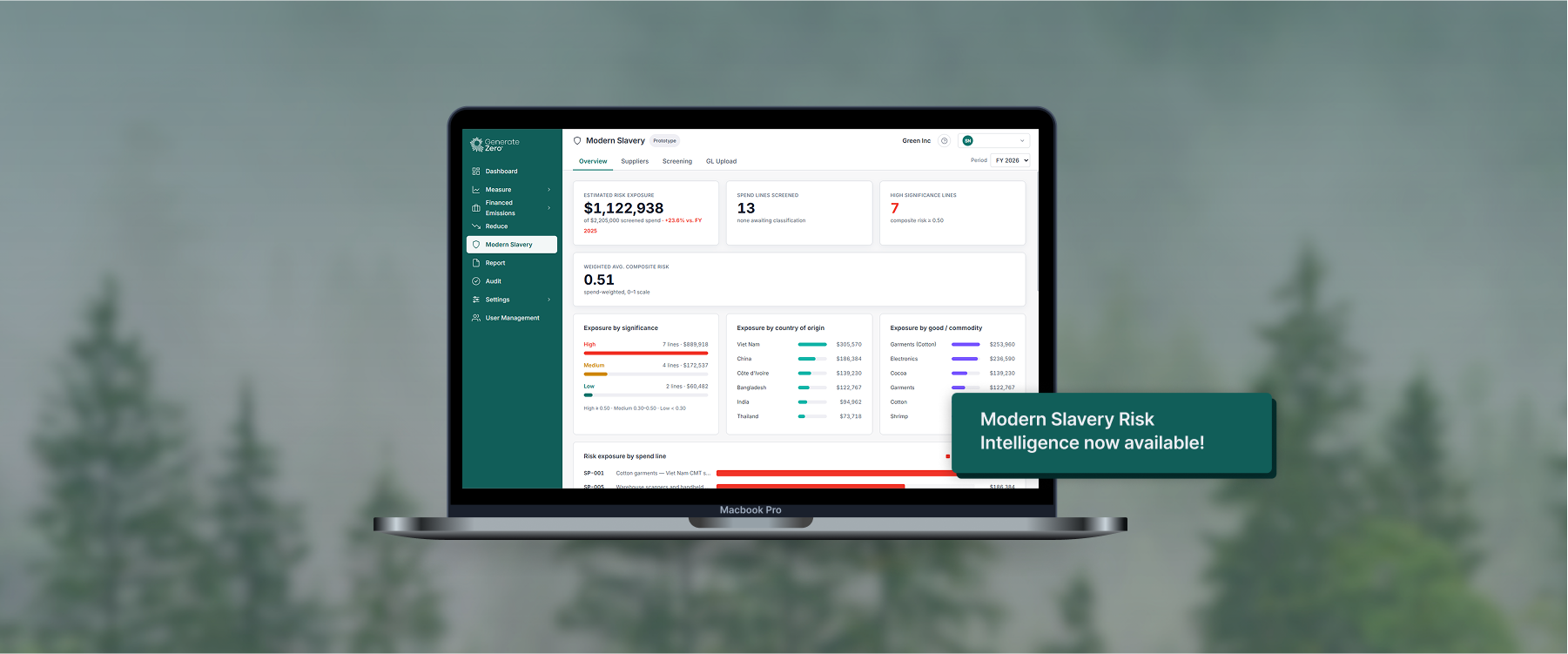
Identify, assess and monitor modern slavery risk across your supply chain. Turn compliance obligations into actionable, audit-ready insight.
.png)
Measure and manage AI and cloud emissions with audit-ready data. Gain real-time visibility, reduce cost, and meet disclosure requirements.

Explore how MFAT’s solar project delivers cost savings, emissions reduction, and how scenario modelling supports smarter sustainability decisions.


