Who Owns AI Emissions? The Accountability Gap Organisations Need to Address
Read moreIdentify, assess and monitor modern slavery risk across your supply chain. Turn compliance obligations into actionable, audit-ready insight.


February 14, 2025


As climate-related financial disclosure becomes a global standard, both New Zealand and Australia have introduced mandatory climate reporting frameworks that require organisations to disclose their greenhouse gas (GHG) emissions, reduction targets, and related strategies. While both frameworks are structured around four core areas - governance, strategy, risk management, and metrics and targets - organisations operating across the Trans-Tasman must navigate the requirements of two disclosure standards. In particular, the specific requirements of each reporting standard for GHG metrics and targets reveal key similarities and differences.
Common Frameworks and Alignment
Both New Zealand and Australia have structured their climate reporting in alignment with international standards, particularly the Task Force on Climate-related Financial Disclosures (TCFD). When it comes to GHG emissions metrics and targets, both standards require organizations to disclose:
Key Differences Between NZ CS1 and AASB S2
Despite their alignment, New Zealand's NZ CS1 and Australia's AASB S2 differ in some important areas:
GHG Protocol Alignment
Alignment to international agreements
Assurance Requirements
Implications for Businesses
For businesses operating in both New Zealand and Australia, understanding these nuances is vital for compliance and strategic decision-making on GHG inventory management. The different requirements under both disclosure standards mean that Trans-Tasman entities reporting under both standards should consider things such as:
The Value of Carbon Accounting Software
As compliance requirements become more complex, investing in carbon accounting software can significantly ease the burden of GHG reporting. These platforms offer several benefits, particularly for Trans-Tasman organisations navigating both NZ CS1 and AASB S2 frameworks:
Both New Zealand's NZ CS1 and Australia's AASB S2 represent significant steps towards access to transparent, comparable emissions data for investors and stakeholders. At this early stage, it’s critical that businesses leverage software to efficiently manage the task of accounting and reporting their GHG emissions. The Generate Zero Footprint software has been designed to support both Australian and New Zealand climate reporting entities with their disclosures. The platform has been independently reviewed to ensure it meets the global reporting standards and the report outputs are audit ready so reporters can disclosure with confidence.
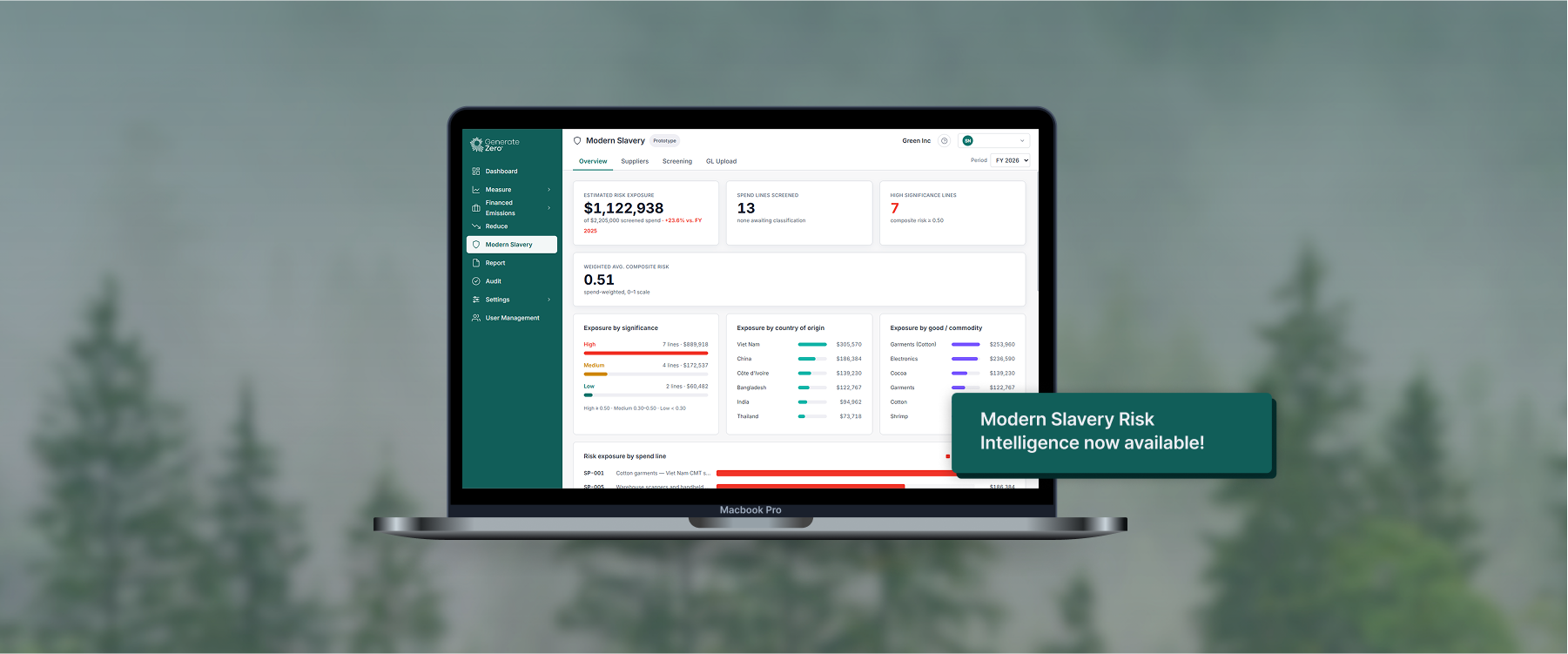
Identify, assess and monitor modern slavery risk across your supply chain. Turn compliance obligations into actionable, audit-ready insight.
.png)
Measure and manage AI and cloud emissions with audit-ready data. Gain real-time visibility, reduce cost, and meet disclosure requirements.

Explore how MFAT’s solar project delivers cost savings, emissions reduction, and how scenario modelling supports smarter sustainability decisions.
Get our latest thinking, product updates and practical insights on the sustainability challenges organisations are navigating, from financed emissions and cloud and AI emissions to modern slavery risk and beyond.
We'll share what we're seeing, building and learning as the landscape evolves.


